This article originally appeared in The Bar Examiner print edition, Fall 2026 (Vol. 95, No. 3), pp. 25–28.By Daphne C. Mills, PhD

Joe E. Covington
In 1999, the National Conference of Bar Examiners created an award to honor the memory of the late Joe E. Covington, who served as NCBE’s first Director of Testing.1 Covington, dean emeritus of the University of Missouri at Columbia School of Law at the time of his passing, was pivotal in the creation of the Multistate Bar Examination (MBE).
The Early Years
Initially known as the Joe E. Covington Prize for Scholarship in Bar Admissions Topics, the award sought research submissions on specified topics related to bar admissions and was open to a wide range of applicants, including judges, lawyers, measurement professionals, law professors, and students.
Between the 2002 and 2003 award cycles, the Covington Award criteria were revised to focus on research on bar admissions testing and limit its recipient pool to doctoral students; a formal name change followed to reflect this new emphasis. Awardees would work with a faculty advisor to complete their proposed project within a 6- to 12-month time frame, and each received an award stipend.
For additional information about the first decade of the Covington Award, I strongly recommend reading the overview published in The Bar Examiner in 2010.2 It provides a detailed history, including the award’s evolution during its foundational years and a brief overview of early topics and recipients.
2011 to the Present: A Shift in Focus
Although measurement and evaluation have been cornerstones of the Covington Award since 2003, the award experienced a second reinvention in 2011. Now known as the Covington Award for Research on Testing for Licensure, it provides support for doctoral students in any discipline conducting research relevant to testing and measurement, particularly in a high-stakes licensure setting. The time frame and structure remains the same, but the award now allows for a greater variety of topics related to testing and measurement as long as they are germane to licensure testing.
Relevance and applicability to bar examinations are still considered during the evaluation process, and several awardees have utilized MBE data for their analyses since 2011. The annual calls for proposals typically highlight several current topics of interest within testing and measurement, such as novel or enhanced approaches to test development, administration, and scoring. Proposals submitted for the Covington Award have examined all testing phases, from development to administration to scoring, and are highly applicable to NCBE’s work.
Covington Award Recipients
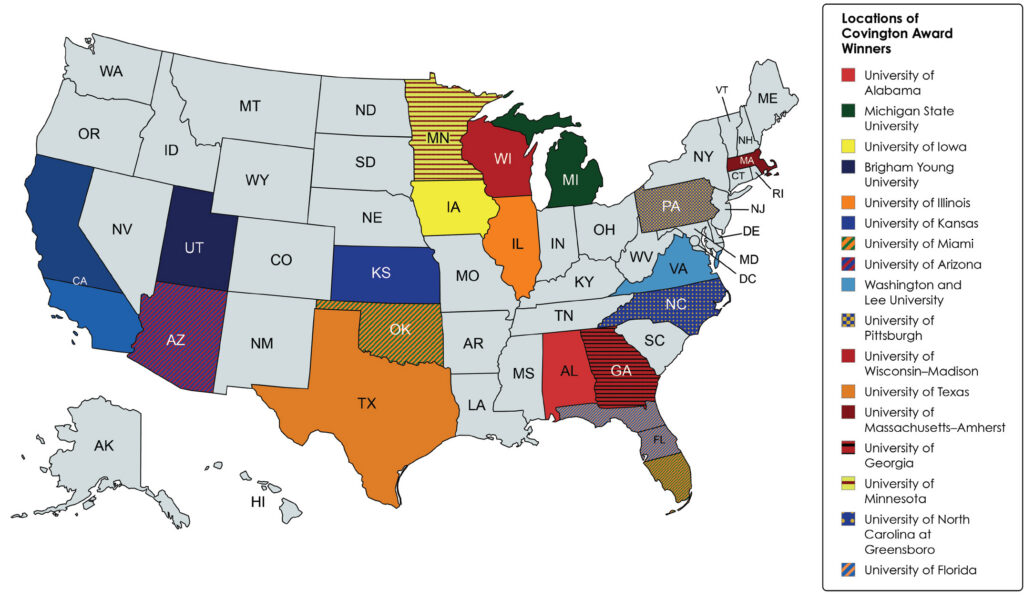
Covington Awards have been granted on 24 occasions, with no awards granted in 2001, 2002, and 2014. Since 2003, there have been 29 award recipients from 19 universities across the United States (see Figure 1). Table 1 highlights the university affiliations of Covington Award recipients, including number of times awarded and year of the most recent grantee. There have also been multiple recipients during five award cycles (2003, 2006, 2009, 2010, and 2016).
Since 2011, awarded research has examined a variety of topics within testing and measurement, including testing accommodations on the MBE, subscore analyses, cheating and testing fraud, models of item response theory, and examinations of factors that can affect the psychometric properties of licensure testing over time (e.g., parametric drift, differential item functioning). Covington Award recipients have presented research at national conferences, including those of the National Conference on Measurement in Education and American Educational Research Association. Their work has been published in peer-reviewed journals such as Applied Measurement in Education and Applied Psychological Measurement. With the launch of the NextGen UBE, research conducted by Covington Award recipients, and within the larger measurement and testing community, continues to play a crucial role in NCBE’s mission of promoting fairness, integrity, and best practices in admission to the legal profession for the benefit and protection of the public.
A list of award-winning topics is listed below. Additional information about the Covington Award can be found at ncbex.org/statistics-research/covington-award.
Table 1. University Affiliation of Covington Award Recipients and Most Recent Award
| University | Number of Awards | Most Recent Award |
|---|---|---|
| University of Alabama | 1 | 2026 |
| Michigan State University | 2 | 2025 |
| University of Iowa | 8 | 2024 |
| UMass Amherst | 2 | 2023 |
| University of Minnesota | 2 | 2022 |
| University of North Carolina at Greensboro | 1 | 2021 |
| University of Miami (FL) | 1 | 2019 |
| University of Florida | 1 | 2016 |
| University of Illinois at Urbana–Champaign | 1 | 2015 |
| University of Kansas | 1 | 2013 |
| Brigham Young University | 1 | 2012 |
| University of California at Los Angeles | 1 | 2011 |
| University of Texas at Austin | 1 | 2010 |
| University of Wisconsin–Madison | 1 | 2010 |
| University of Georgia | 1 | 2009 |
| University of Pittsburgh | 2 | 2007 |
| University of California at Berkeley | 1 | 2006 |
| University of Arizona | 1 | 2004 |
| Washington and Lee University | 1 | 2000 |
Covington Award Recipients and Projects, By Year
- 2026: “Sensitivity of Residual PCA in MFRM: Design-Based Missingness and Aggregation,” Mirai Nagasawa, University of Alabama
- 2025: “A Review of Machine Learning-Based Approaches for Detecting Test Fraud,” Daihui (David) Xiao, Michigan State University
- 2024: “Investigating Psychometric Properties of Scale Scores on Mixed-Format Tests Using IRT,” Juyoung Jung, University of Iowa
- 2023: “Machine-Learning-Augmented Logistic Regression Procedures for Identifying Complex DIF Structures,” Nathaniel Smith, University of Massachusetts Amherst
- 2022: “A Review of Measurement Challenges in Technology-Enhanced Item Types in Licensure Examinations,” Özge Cinar, University of Minnesota
- 2021: “A Comparison of Various DIF Detection Methods under Small Samples,” Haeju Lee, University of North Carolina at Greensboro
- 2020: “A Comparison of Procedures to Detect Item Parameter Drift under 3PL and Rasch Models,” Kuo-Feng Chang, University of Iowa
- 2019: “A Deterministic Gated Lognormal Response Time Model to Identify Examinees with Item Preknowledge,” Murat Kasli, University of Miami (FL)
- 2018: “Multidimensional Item Response Theory Equating for Domain-Based Tests,” Stella Kim, University of Iowa Center for Advanced Studies in Measurement and Assessment
- 2017: “Validity and Reliability of Subscores and Profile Analysis,” Jinah Choi, University of Iowa Center for Advanced Studies in Measurement and Assessment
- 2016: “Multiple Group Concurrent Calibration Under the Three-Parameter Logistic Model,” Kyung Yong Kim, University of Iowa Center for Advanced Studies in Measurement and Assessment; “Accommodations for Examinees with Functional Impairment on Multistate Bar Exams: A Literature Review,” Ren Liu, University of Florida Research and Evaluation Methodology
- 2015: “Nonparametric Informational Distance/Divergence Approach to Detect Item Parameter Drift in Multidimensional Tests,” Hyeon-Ah (Annie) Kang, University of Illinois at Urbana–Champaign
- 2013: “Review of Parameter Drift Methodology and Implications for Operational Testing,” Amy Clark, University of Kansas
- 2012: “Statistical Methods to Detect Cheating on Tests: A Review of the Literature,” TJ Bliss, Brigham Young University
- 2011: “Characterization of the Sources and Consequences of Measurement Error in Test Score Estimates,” Mark Hansen, University of California at Los Angeles
- 2010: “Investigating Multiple Ability Factors on the Bar Examination Using Two Measurement Models: A Multidimensional Latent Trait Model and a MIMIC Model,” Su-Young Kim, University of Wisconsin–Madison; “Applying the Multistage Test Approach to the Multistate Bar Examination,” Jiseon Kim, University of Texas at Austin
- 2009: “Examination of Test Speededness Effects on the Multistate Bar Exam,” Aijun Wang, University of Georgia; “Estimating Decision Indices for Composite Scores Using a Simple-Structure Multidimensional IRT Framework,” Tawnya Knupp, University of Iowa
- 2008: “Evaluating Equity in Equating Using Test Characteristic Curves,” Adam E. Wyse, Michigan State University
- 2007: “An Evaluation of Different Approaches to Subscore Augmentation for the Multistate Bar Examination,” Xiaowen Zhu, University of Pittsburgh
- 2006: “Rasch and Multidimensional Rasch Analysis of the MBE Items,” Ou Lydia Liu, University of California at Berkeley; “Estimating Classification Consistency for Complex Assessments,” Lei Wan and Robert L. Brennan, University of Iowa
- 2005: “Item Response Theory Parameterization of the Multistate Bar Exam,” Nathan A. Thompson, University of Minnesota
- 2004: “A Substantive Process Validity Study of Multistate Bar Examination Items Through Verbal Protocol Analysis,” Sarah M. Bonner, University of Arizona
- 2003: “A Multivariate Generalizability Analysis of the Multistate Bar Examination,” Ping Yin, University of Iowa; “Assessing the Dimensionality and Factor Structure of Multiple-Choice Exams: An Empirical Comparison of Methods Using the Multistate Bar Examination,” Chien-Chi Yeh, University of Pittsburgh
- 2000: “Hate and the Bar: Is the Hale Case McCarthyism Redux or a Victory for Racial Equality?” W. Bradley Wendel, Washington and Lee University
Figure 1. Location of Covington Award Recipient Institutions
Notes
- For a brief remembrance of Covington, see “Remembering a Few Trailblazers,” 90(2–3) The Bar Examiner 20–23 (Summer/Fall 2021). (Go back)
- Andrew A. Mroch, PhD, “The Joe E. Covington Award: Twelve Years of Encouraging Research on Testing for Licensure,” 79(2) The Bar Examiner 31–33 (May 2010). (Go back)
 Daphne C. Mills, PhD, is Research Specialist for the National Conference of Bar Examiners.
Contact us to request a pdf file of the original article as it appeared in the print edition.